
Men of Science, Masters of Hover
By Krista Burns
A hovercraft is a feat of engineering. An amphibious craft capable of travelling over land and water, the design of an air-cushion vehicle weaves together many different areas of engineering. So naturally, alumni from across Carnegie Mellon’s College of Engineering would be interested in creating their own ground-effect machine.
For the past two summers, engineering graduates from the Carnegie Mellon Class of 1984, Richard DeFelice (MechE), Dr. Keith DeVos (ECE and Physics), and Adam Rizika (MechE), have gathered in Biddeford, Maine to design and build The Flying Pig, a personal hovercraft fabricated over a 10-plus day engineering marathon.
After a career in technology companies like Teradyne and PTC, Rizika rediscovered hands-on building through family projects.
“About 15 years ago, I started building things with my kids,” explains Rizika. “We began with Halloween haunted houses, inspired by CMU Carnival Booths, then moved on to a potato launcher, rockets, and a trebuchet. Once my kids were older, the projects had to grow, too. When we decided to build a hovercraft, I knew I needed the help of real engineers. So I called my old friends, Richard and Keith.”
Rizika reached out to Richard DeFelice, his freshman roommate in Hamerschlag Hall and longtime friend, and to Keith DeVos, a classmate and former cross-country runner he hadn’t seen in decades. The three had crisscrossed paths at CMU in the early 1980s, studying, inventing, and occasionally mischief-making in the halls of Hamerschlag. Reuniting, they found that the spirit that first drew them to engineering hadn’t faded a bit.
Gathered in Rizika’s garage, the trio began to create the hovercraft from blueprints in DeFelice’s head, with design improvements as needed to yield a flying hovercraft. With no specific goal except for having fun and reconnecting, the engineers launched what would become a yearly summer tradition, The Hovercraft Hackathon.
DeFelice served as lead engineer, drawing on a career that spanned semiconductor reliability testing at AT&T, intellectual property negotiations at AT&T & Lucent, ventures launching technologies from Bell Labs and building his own businesses. “Engineering never leaves you,” he said. “This kind of project brings back that CMU spirit of inquiry, persistence, teamwork, and a sense of play.”
After a few days of brainstorming, they quickly realized their original five-day build plan was a bit optimistic, and that they would need a few more helping hands. They enlisted the assistance of their friends, Tim Wegner (Northeastern BSEE) and Steve Luby (UMASS BSME) without whose contributions, the craft may have remained just a fun idea.
“We also decided to invite some younger folks to help us build,” says Rizika. “Our goal for the younger crew was to provide them with hands-on learning - designing, using tools, collaborating, and having fun. For the older engineers, it was about working together creatively on something outside of work. We ended up needing that balance.”
That first Hovercraft Hackathon resulted in a team of nearly twenty participants. They worked in shifts, cutting, assembling, testing, and redesigning. After many failed attempts, the team kept altering their design until the craft finally hovered on ground.
“Who knew it would take ten days of twelve-hour shifts just to get it hovering?” Rizika laughed. “Then another week to get it steering straight and stopping safely. But the process was pure CMU, hands-on learning, iteration, and teamwork.”
For DeVos, a neurologist and longtime teacher now based in Tennessee, the experience rekindled not just friendships but also memories of the intellectual spark CMU ignited.
“I came to CMU as a kid who loved science and math,” says DeVos. “I had no idea what I wanted to do, only that it would involve figuring out how the world works. That’s what CMU gave me, not just the skills, but the mindset.”
DeVos, who studied under Vijayakumar Bhagavatula, the U.A. and Helen Whitaker Professor of Electrical and Computer Engineering, carried that mindset into every stage of his life, from signal processing research at Johns Hopkins to a career in neurology and medical education.
“Even now, I see the nervous system as an amazing cellular computer, with many intertwined and interdependent circuits, many that operate as control systems with feedback loops” says DeVos. “Engineering and physics shape the way I think about everything and help guide me to be a logical problem solver in medicine.”
Reconnecting with Rizika and DeFelice felt like stepping back into the best parts of college.
“It reminded me of why we all fell in love with engineering in the first place — the collaboration, the problem-solving, the sheer fun of discovery,” says DeFelice. “It felt like being back at CMU again, late nights, creative minds, everyone pitching in to make something work.”
By their third week together, the group had launched Hovercraft Hackathon III, improving their design and pushing for new speeds and navigation ability. There’s even a theme song, an AI-generated tune created just for the occasion.
“It’s all in good fun,” DeFelice said. “But it also shows how engineering connects generations. Everyone learns something, and everyone contributes.”
The trio plan to keep building. Maybe faster hovercrafts, maybe something new. But what matters most, they agree, is the collaboration itself.
“It’s not about what we build,” Rizika said. “It’s about who we build it with, and what it brings out in us. Every time we do one of these projects, it feels like we’re back at CMU again.”
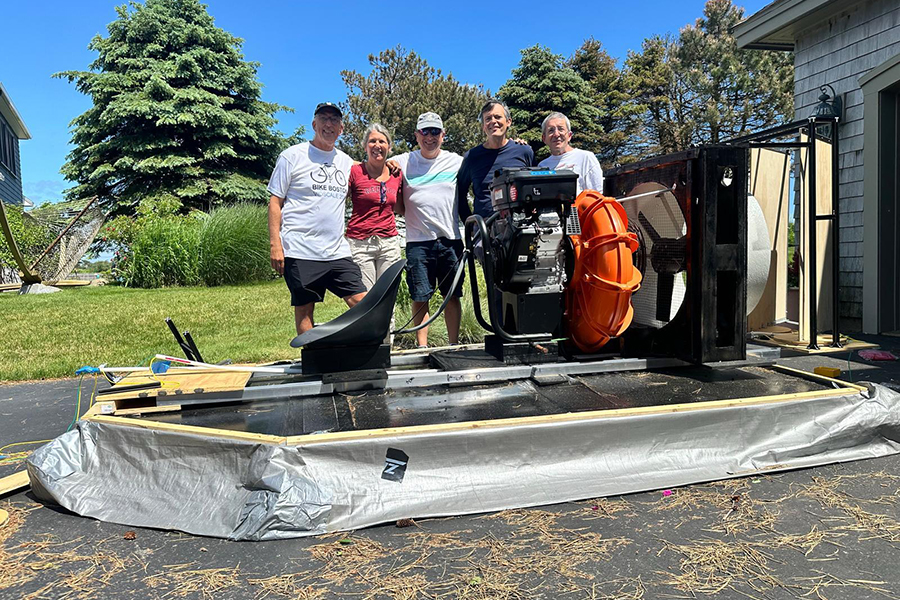
An early stage of the Hovercraft with Adam Rizika, his wife Ellen, friend Tim Wegner, Richard DeFelice, and Keith DeVos.

DeFelice (sitting on the ground in the gray shirt), Rizika (blue shirt), and DeVos (pink shirt) working on the propeller housing with Michael Marom (son of late CMU alumnus, Eran Marom) and Anika Staunton (BS HM, University of Central Florida).